
19.10.2026 / 08:00
AI-Based Hedging of Renewable PPAs
Energy Markets
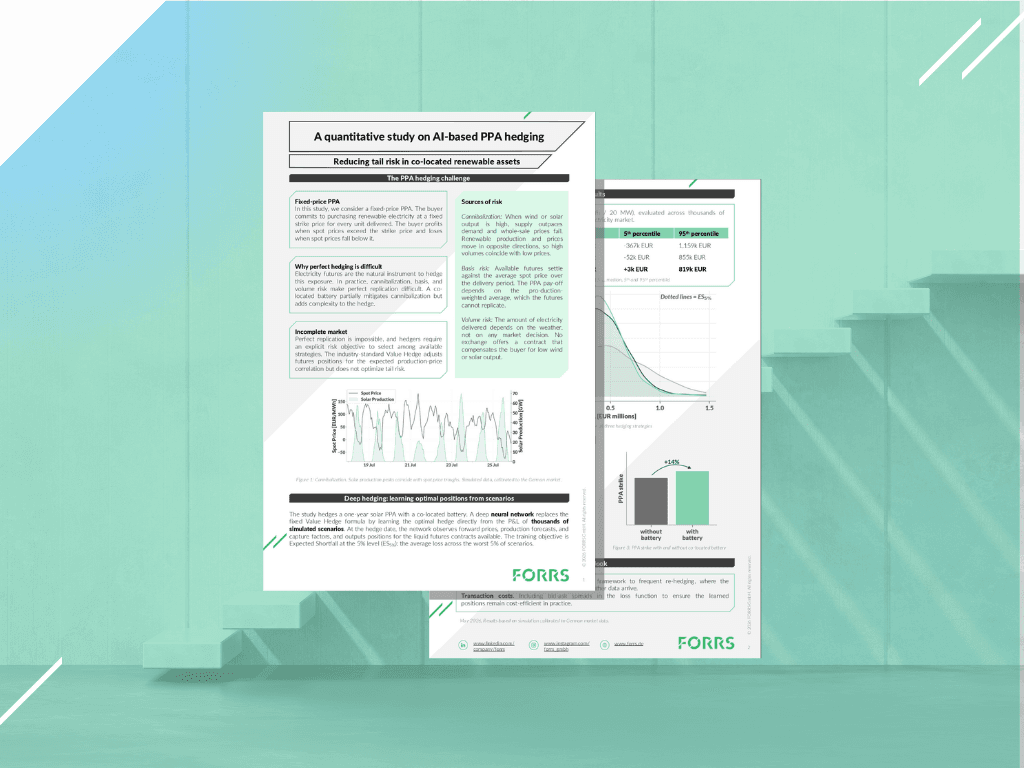
Renewable power purchase agreements are becoming an increasingly important part of the energy market. However, effectively hedging the risks embedded in a fixed-price PPA remains challenging.
Although the contractual price may appear straightforward, the underlying exposure is shaped by three interconnected effects:
Cannibalization: When renewable generation peaks, many assets produce simultaneously, putting downward pressure on the captured power price.
Basis risk: Standard futures contracts settle against the average spot price, while PPA revenues depend on the production-weighted captured price.
Volume risk: Renewable output varies with weather conditions, and conventional futures do not compensate for periods of unexpectedly low generation.
Because generation volumes and captured prices are correlated, these effects cannot be considered independently. The resulting P&L distribution is typically skewed, with a relatively small number of scenarios accounting for a large share of potential losses.
The industry-standard Value Hedge determines the futures position using the expected capture factor—the average relationship between the captured price and the baseload price. While this approach can effectively hedge the expected outcome, it is calibrated to a single average value and may therefore leave the most adverse scenarios under-hedged.
In this quantitative study, we examine an alternative approach based on deep hedging. A neural network is trained on thousands of simulated German power-market scenarios and optimized directly against Expected Shortfall, focusing specifically on the worst 5% of outcomes. Unlike a fixed-formula hedge, the model adapts the hedge position to prevailing market conditions at the time of execution.
We also analyze how combining the renewable asset with a co-located battery can further reduce risk and create additional value. The results show a substantial reduction in losses under adverse market scenarios, while preserving the median P&L.