26.02.2026 / 08:30
The Evolution of Data for Enterprise Risk Management in an Energy Company
Energy Markets
For decades, Enterprise Risk Management (ERM) in the energy sector has concentrated on market volatility, credit risk, and operational safety. However, a new systemic factor has appeared that is fundamentally different: climate-driven physical risk. Unlike traditional financial risks, climate risk is non-stationary.
As regulators – particularly in the UK – move to treat climate risk equally with market and credit risk, the energy sector must shift from relying on historical data to incorporating forward-looking stochastic data and analytics.

The Direct Link: Climate Variability and Energy Performance
The shift to a renewable-dominated grid has established a direct, heightened sensitivity connection between climate patterns and asset-level performance. In the traditional energy sector, a power plant’s fuel was a commodity with a market price. In the renewable sector, the “fuel” is the climate itself.
Solar generation: Variations in cloud cover patterns and local ambient temperatures directly influence photovoltaic output. A 2-degree Celsius rise in local temperature can reduce solar cell efficiency, thereby affecting the asset’s Internal Rate of Return (IRR) during the mid-lifecycle.
Wind generation: Like solar panels, wind turbines tend to perform better in colder conditions. However, for wind turbines, this is because denser air carries higher kinetic energy, a different mechanism from that affecting solar panel performance. Variations in local wind shear and the frequency of “wind droughts” can cause substantial revenue shortfalls. If climatological drift at a specific site is not accounted for in the asset’s financial model, it can lead to overestimation or underestimation of the asset’s value. Both excessive and insufficient wind levels can pose challenges.
Transmission lines are considered “linear assets” that are exposed to climate-related physical risks at multiple sites, potentially under different hazard conditions.
The Adaptation-Efficiency Nexus
An often neglected, yet key aspect of climate ERM is the connection between infrastructure adaptation and energy efficiency. In the energy sector, adaptation is usually seen as a “cost” of strengthening assets against extreme weather. However, a detailed risk analysis uncovers a dual benefit:
1. Structural Resilience as an efficiency enhancer: Strengthening a structure to endure extreme heat or storms typically involves upgrading materials and building envelopes. These modifications often lead to significantly reduced energy costs and lower operational baselines.
2. Optimizing the Balance Sheet: By viewing adaptation through the lens of efficiency, risk managers can shift from “disaster mitigation” to “performance optimization”. An adapted asset is not just safer but also more cost-effective over its lifecycle.
Geographic Non-Equivalence in Enterprise Risk
Traditional energy ERM often considers identical assets, such as two substations or two LEED-certified office buildings, as having similar risk profiles within the same asset class. Climate analysis shows that this is a misconception.
The Coordinate-Specific Risk: Two identical buildings in different locations face markedly different systemic risks. One may be threatened by subsidence from drying clay soils, while the other, just a few kilometres away, faces hazards like flash flooding or equipment failure caused by extreme heat.
The Granular Gap: Without a climate-first approach, an enterprise risk report may misclassify these assets, thereby obscuring the “geographic tail risk”. Real estate and energy portfolios require analysis at the coordinate level to identify where ‘standardized’ infrastructure fails due to local climate variations.
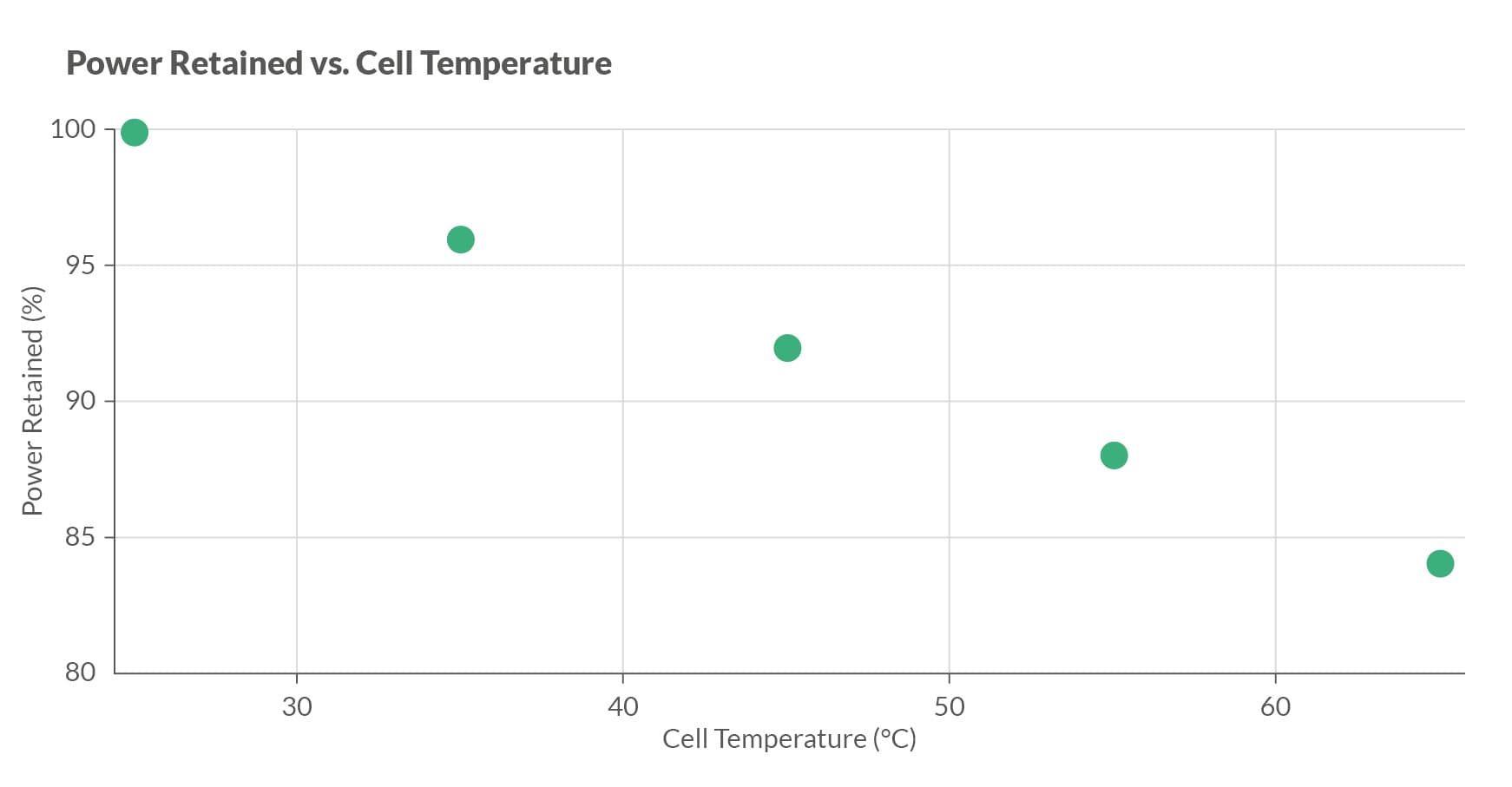
Figure 1: Power Retained vs. Cell Temperature
Technicalities of Geospatial Granularity
Energy assets, such as a single wind turbine, a substation, or a section of the transmission grid, are “small” data points in a geospatial sense, but they carry significant financial weight.
Spatial Resolution vs. Relevance: Standard climate models operate on grids of 100km or more. For an energy asset, we must use downscaled data that considers local topography and microclimates. A wind turbine on a ridge faces a different risk profile than one in a valley a kilometer away.
Geospatial Data Governance: Unlike financial trades, geospatial climate data requires a strict governance framework to ensure that the “lineage” of the data point is clear. The provenance of the geospatial coordinate is as important as its value.
The Burden of Forward-Looking Derived Data
Regulators now require forward-looking data, but this data is mostly “derived” – it results from complex models rather than direct observation. This also involves managing significant uncertainty.
The Validity of Derivation: When we derive a 2040 wind-speed projection, we combine model assumptions with uncertainties in the carbon pathway.
The Governance of Uncertainty: It is no longer enough to report just a single number. We need to show the range of outcomes and how sensitive the data is. If a risk manager cannot explain the “why” behind a derived climate metric, that data becomes a liability rather than an asset.
From Deterministic to Stochastic
To align climate risk with market and credit risk under UK regulations, we need to treat climate data as stochastic. However, this affects the analytics used.
The ClimateEarthDigitalTwin™: At RiskThinking.ai, we utilize a “digital twin” approach to run thousands of potential future scenarios for a specific asset location.
Multifactor stress testing is essential because many factors can influence an asset over time. This enables us to identify the “tail risks” that deterministic models often overlook.
These stress tests must be generated algorithmically, as it is impossible for humans to consider all possibilities. From a governance perspective, we need to assess the accuracy of these simulations.
Multivariate Analysis: We must integrate physical climate variables with financial variables. A physical risk event often coincides with a market risk event but also managing them separately is no longer practical.
Protecting the Balance Sheet
Integrating climate data into ERM is more than just a compliance task. It is a fiduciary duty. By using a science-based stochastic approach that considers geographic non-equivalence and the connection between adaptation and efficiency, energy companies can identify which assets are genuinely resilient and which are “financially stranded”.
Naturally, in this article, we have only just touched on the applications to the energy sector. There are clearly more areas affected by climate.