19.02.2026 / 08:30
Entrepreneurs, Leadership, and Risk Management – Think About Risks, Not Rules
Energy Markets
Interview with Gerhard Stahl
Risk management has become a strategic cornerstone for the energy sector amid regulatory shifts and structural transformation. Few experts understand this better than Gerhard Stahl, who shares his perspectives on the role of regulation, emergent risks, and the vital interplay of CFOs and CROs in balancing resilience, agility, and value creation.
FORRS: Which social and regulatory developments that affect risk management should currently be on the energy sector’s radar?
Gerhard Stahl: Almost four decades ago, Lyotard’s and Beck’s prophetic societal analyses of postmodern societies captured the ciphers of our present-day world conceptually as a risk society. In Europe, risks are preferably addressed through avoidance strategies (the current mantra is resilience), which, in their formal implementation, incline towards bureaucracy.
The updated requirements of the auditors’ examination standard (IDW PS 340) specify requirements for risk early-warning systems that are relevant for the energy sector. This is true both from endogenous perspectives (proprietary trading and energy producers) and exogenous ones (the decisive role in transforming climate risks).
FORRS: What organizational and strategic challenges do you see in implementing these new auditing standards under IDW PS 340 for energy companies?
Gerhard Stahl: In energy trading and generation, optimized business models of energy companies create requirements for risk systems that make fruitful communication necessary. For example, communication between the CFO of a holding company and the risk manager (CRO) of a trading subsidiary is imperative.
For small and medium-sized companies, this raises the question of efficient and effective implementation. In this context, the CFO materially assumes the role of a “primus inter pares”.
From an economic perspective, developing enterprise value, understood as the sum of the balance sheet surplus and the present value of future cash flows, is the focus of both internal and external stakeholders. The many successes and disappointments of countless M&A projects reveal the opportunities and uncertainties inherent in these ventures.
The graphic below brings together many components of modern corporate management. Harmony and consistency between the planning process (CFOs) and the perception and quantification of uncertainties at the holding level (CFO) and in subsidiaries (CRO) play a key role.
The balance sheet (or values derived from it) serves as a success criterion for many decisions and strategies. The projection of a balance sheet maps risks that are known today over a period. However, this approach can only, to a limited extent, be transferred to the value of future cash flows, as emergent uncertainties (in extreme cases, “black swans”) come into play.
Frank Knight already recognized this basic structure of categorizing non-knowledge in 1921 in his groundbreaking work Risk, Uncertainty, and Profit. He understood entrepreneurs as takers of emergent risks or uncertainties.
This marks the essential distinction between a CFO of a holding company and the CRO of a trading subsidiary. CROs use key techniques of derivatives pricing in determining risk and understanding risk as the price change of their investment portfolio. In other words, they act from the perspective of a technical expert.
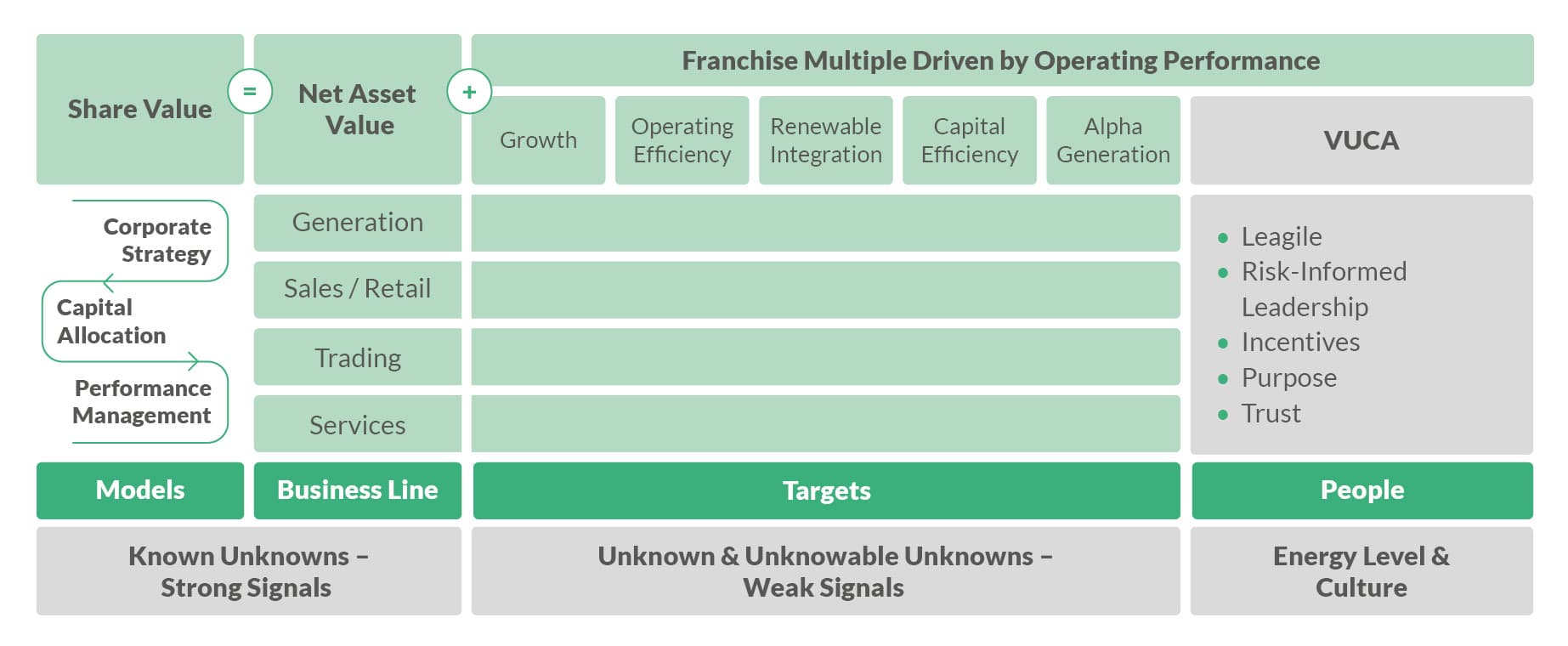
Figure 1: Value Creation Framework - Risk Projection from Known Risks to Emergent Uncertainties
FORRS: How can companies methodically capture and assess emergent risks of future cash flows?
Gerhard Stahl: In principle, pricing-based, bottom-up approaches would be suitable here. However, their technical requirements (stochastic single-period models) prevent the desired strategic business application.
With top-down approaches, which are comparable to methods such as Earnings at Risk (EaR), a consistent modeling framework has the advantage of actively involving decision-makers. They can incorporate their view of emergent risks into the models, transforming each model from a pure forecasting tool into an instrument of learning (adaptation to the environment). The importance of this in a dynamic, and indeed disruptive, economic environment hardly needs to be emphasized.
FORRS: What role can regulation play in the quantification of emergent risks, and where are its limits?
Gerhard Stahl: This approach, guided by necessity, common sense, and the responsibility that comes with it, shows how the question of dealing with bureaucracy can be answered. Communication grounded in trust and responsibility prevents bureaucracy from arising in the first place.
Industry practices in the financial sector show that overregulation is not only a significant cost factor but also slows down processes in a dynamic environment. Moreover, it lulls users into a deceptive sense of security and overconfidence through compliance with regulations that appear to be all-encompassing.
In summary, the noble task of the executive board is to create a balance between risk and freedom. The entrepreneur is deemed ideal.
FORRS: We have talked a great deal about the quantification of known and emergent risks and their importance for future decisions and strategies of an energy company. What does this mean for the planning process and financial plan of a CFO, which largely determine a company’s investments?
Gerhard Stahl: This question strikes at the very core of the matter. A CFO conducts earnings (risk) management based on the planning process. Often, there is no ideal linkage between the target-driven perception of risk and bottom-up models.
Experiences with supply chain risks, particularly during and after the COVID pandemic, led to discrete dynamic models aimed at causalities and the development of alternative courses of action. If one takes a CFO’s risks as the starting point, scenario techniques enable them to decide between probability-weighted alternatives of action. The focus is on value-creating courses of action rather than distributing value changes.
FORRS: In the future, will the energy sector and energy trading in particular be more heavily regulated, similar to developments in the financial sector over recent decades?
Gerhard Stahl: Regulatory systems tend to underestimate the learning capability of systems, which can often lead to bureaucracy. Bureaucratic rulebooks are often accompanied by overconfidence, as regulations, perceived as absolute, convey the impression that they are exhaustive.
However, complex times require high degrees of freedom (Ashby’s Law) to implement potential adaptations in an agile manner. These requirements argue against regulation.
From a legal perspective, proprietary trading of energy instruments (such as commodities) constitutes trading activities. These are subject to regulation by the Federal Financial Supervisory Authority (BaFin). There are also many substantive reasons in favor of this, including the prevention of (regulatory) arbitrage, systemic risks, and the “golden supervisory rule”: same risk, same rule.