04.02.2026 / 08:30
Earthquakes and Tectonic Shifts in Energy Markets
Energy Markets

Digitalization, AI, decentralization, and decarbonization are fundamentally reshaping energy markets, triggering structural breaks in prices, volatility, and correlations. Risk leaders must move beyond cycle-based, history-biased models toward multi-horizon approaches that incorporate geopolitical and climate risks, as well as AI-driven spillovers.

The production, trade, and infrastructure of energy across power generation, heat, fuels, and natural resources have long been fundamental drivers of economic growth. However, over the past decade, exposure to energy market shocks has become broader, faster-moving, and tightly interlinked with the rest of the economy.
Energy risk is no longer confined to utilities or heavy industries. It is now affecting households, supply chains, financial markets, and public budgets in every major economy. This article outlines the risks to watch, questions to consider, and decisions to make for risk managers, traders, and corporate leaders.
Three Tectonic Shifts
1. Digital Transformation and AI
The first major structural shift is digital transformation. Energy systems have moved from analog and paper-based processes to digital records, automated workflows, and data-driven decision-making. Smart meters, real-time sensors, and cloud-based platforms have dramatically increased the volume and granularity of operational and market data.
Building on this foundation, artificial intelligence (AI) has emerged as a more powerful wave within digitalization. Over only a few years, particularly in the last 12–24 months, AI applications in forecasting, dispatch optimization, algorithmic trading, and risk analytics have moved from pilot projects into daily operations across many energy and trading organizations. This creates clear advantages for firms that can effectively deploy and govern these tools. However, AI also creates new risks, including model uncertainty, feedback loops in algorithmic markets, cyber vulnerabilities, and the danger of overreliance on systems that learn from non-stationary data.
2. Decentralization and Democratization
The second shift is the decentralization and democratization of the power system. Technological advances have enabled households, communities, and industrial consumers to become active participants in energy supply, rather than passive off-takers. Rooftop solar, small-scale wind turbines, behind-the-meter batteries, and demand response programs now allow consumers to generate, store, and actively manage their own energy use.
In many regions, local energy platforms and community schemes facilitate peer-to-peer trading, shared assets, or aggregation of small units into market-relevant portfolios. While each installation is local, their aggregate impact is not. Distributed assets now influence wholesale price formation, grid stability, and cross-border flows. For traders and risk managers, this proliferation of small, data-intensive actors complicates load forecasting, increases the importance of locational risks, and changes the patterns of intraday and seasonal price dynamics.
3. Sustainability, Regulation, and Decarbonization
The third major force reshaping energy markets is the sustainability and climate policy agenda. Decarbonization targets and environmental regulations have evolved from niche constraints into core principles of energy and industrial policy. In the European Union, for example, the “Fit for 55” package aims to cut net greenhouse gas emissions by 55% by 2030, through a comprehensive overhaul of emissions trading, carbon border adjustment, energy taxation, efficiency standards, and renewable targets.
Policies like this affect every stage of the energy value chain, production, processing, transport, and consumption, whether energy is used directly as fuel, converted into electricity, or embedded in materials.
Regulatory measures introduce explicit price signals, caps, and incentives that, when combined with digitalization and decentralization, lead to complex, path-dependent market behaviors. For firms, this means that compliance, carbon exposure, and long-term policy credibility now directly influence asset valuation, hedging strategies, and capital allocation.
Shaken Fundamentals: New Patterns in Demand and Supply Behavior
These three tectonic shifts are not just adding layers to existing markets. They are altering the underlying behavioral patterns on both the demand and supply side. As opportunities, constraints, and objectives change, the energy system exhibits correlation patterns in trends, volatility regimes, and correlation structures that challenge traditional models and heuristics.
On the demand side, households, commercial users, and industrial consumers are increasingly forced to re-evaluate their options across multiple dimensions. These include:
- Fossil fuels versus electrification in heating, mobility, and industrial processes
- Grid-supplied electricity versus local self-generation and storage
- Long-term contracts and delegated portfolio management versus direct participation in wholesale or local platforms
Each of these choices is shaped by technology costs, regulatory incentives, and digital access to information and markets. This results in greater optionality and flexibility in demand, along with greater complexity in forecasting load profiles and price responses.
On the supply side, traditional beliefs about the optimal energy mix and technology portfolio have changed. The COVID19 pandemic and the Russian invasion of Ukraine exposed vulnerabilities in gas supply, pipeline infrastructure, and global commodity chains, pushing security of supply and diversification back to the top of the agenda. Market participants must plan for daily and weekly balancing risks, as well as for seasonal and multiyear shocks.
In this context, commercial storage, both short-term and seasonal, has gained strategic importance, serving not only as a tool for intraday arbitrage but also as insurance against prolonged disruptions. At the same time, limitations on infrastructure and access to critical materials such as copper, aluminum, and lithium have become essential risk factors for power grids, battery deployment, and renewable expansion. These constraints shape the speed, cost, and geographic distribution of the energy transition.
What emerges is a risk landscape that is more volatile, more interconnected, and more strongly influenced by forces outside of traditional supply and demand. Weather patterns and fuel prices still matter, but they now interact with technology adoption, regulatory change, infrastructure bottlenecks, and geopolitics in ways that make simple extrapolation from history increasingly unreliable.
For energy companies, traders, and end users, this means that risk management can no longer focus solely on short-term price fluctuations. It requires multi-horizon approaches that integrate:
- Physical flexibility (generation, demand response, storage)
- Contractual optionality (structured products, long-term offtake, capacity rights)
- Advanced analytics and AI-enabled monitoring
- Scenario-based assessment of structural shifts in policy, technology, and geopolitics
In other words, energy markets are undergoing tectonic changes, and risk management frameworks must ovelove from managing cycles to managing structural transformation.
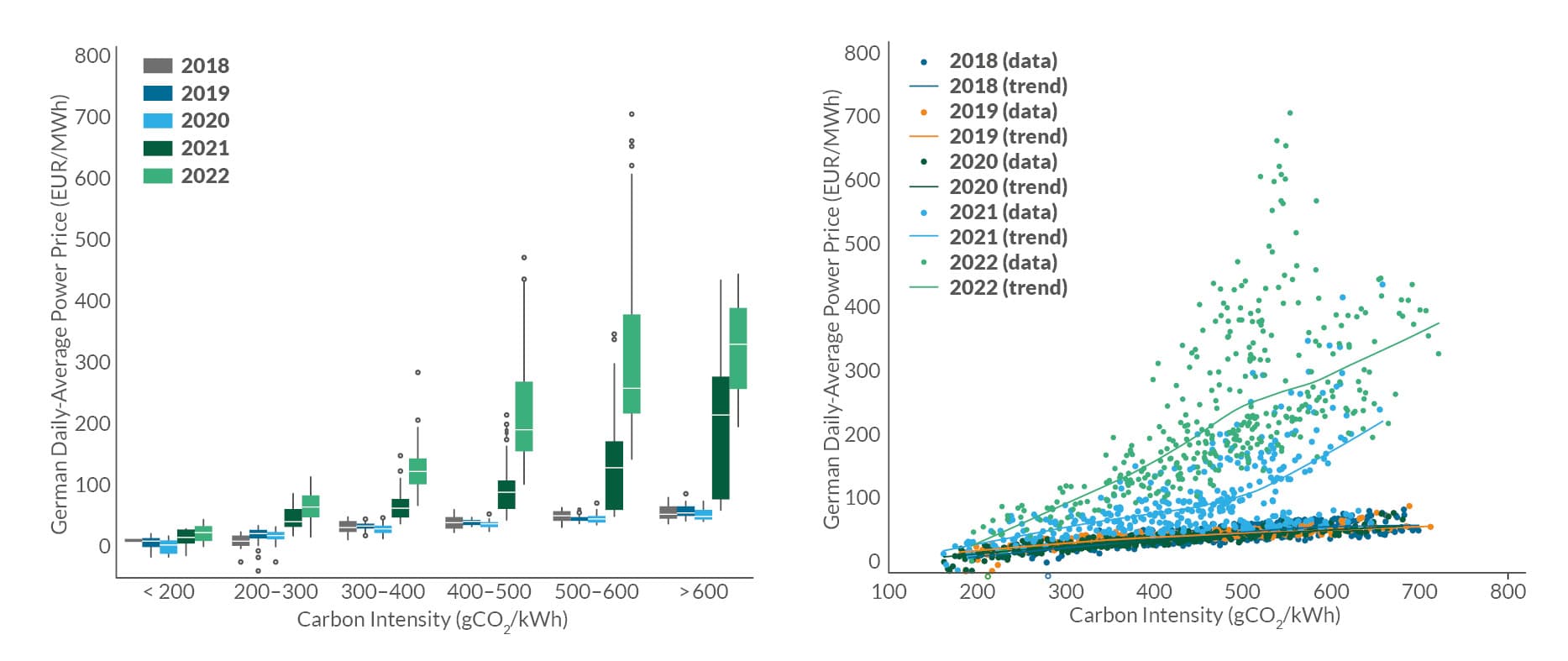
Figure 1: Power Prices and Carbon Intensity in the German Electricity Market from 2018 to 2022. (Graphics modified from Madadkhani & Ikonnikova, 2025)